|
SUMMARY OF RESEARCH
REGULATION OF GENE EXPRESSION AT LARGE DISTANCES BY ENHANCERS DURING T CELL DEVELOPMENT
Our final goal is to contribute to the understanding of the molecular basis for the establishment of specific programs for T lymphocyte differentiation, through the regulation of activation and silencing of heritable gene expression. Lymphocytes are the only cellular types with different genetic information in the nucleus, as result of a process known as V(D)J recombination. This process is responsible for the rearrangement of gene segments disperse in the genome at the immunoglobulin and T-cell receptor (TCR) genes during lymphocyte development for the generation of antigen receptor diversity. In fact, the adaptive immune response in vertebrates depends on the expression of these highly variable antigen-specific receptors that allow us to recognize and generate protection against a universe of diverse pathogens. V(D)J recombination is very precisely controlled in a cell-type and stage-specific manner by enhancers, being these regulatory elements responsible for the critical architectural and chromatin gene changes that occur at different developmental cell stages. Our laboratory is interested in studying the molecular mechanisms involved in TCR enhancer function during T-cell development. The knowledge derived from this research will allows us to understand how enhancers regulate expression of TCR genes through transcription and V(D)J recombination in normal conditions, as well in those conditions that result in gene translocation that drive leukemic transformation. In addition, our group collaborates with other national and international research groups interested transcription, RNA splicing and the use of nanoparticles to deliver nucleic acids into cells and animals. More recently, our laboratory has been involved in a project to characterize the TCR?? repertoire expressed by memory T lymphocytes in COVID-19 convalescent patients. This information will help to identify the public TCR?? among different individuals and might be used to develop new therapies against COVID-19 based on T lymphocyte responses.
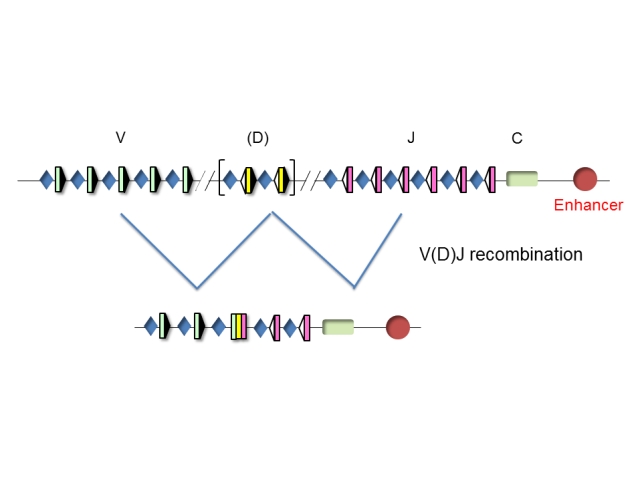 |
Schematic representation of the V(D)J recombination process in a model antigen receptor gene. V, D and J gene segments are represented by vertical rectangles (green, yellow and pink, respectively). The constant region (C) is represented by a horizontal green rectangle, and the enhancer by a red circle. Figure taken from Alonso Rodríguez-Caparrós et al. (2020) Int J Mol Sci 21:8478.
FUNDING AGENCIES LAST 5 YEARS
|
|
- Mecanismos de señalización para el control de la transcripción por enhancers de los genes de las cadenas alfa y delta del receptor de linfocitos T durante el desarrollo. PROYECTO, PN2021 - PROY I+D GENERACION CONOC. - PID, Ref: PID2021-128720NB-I00, (2022 - 2025).
|
|
- EVALUACION DE LA RESPUESTA Y REPERTORIO TCRalfa/beta DE CELULAS CD8+ MEMORIA FRENTE A. PROYECTO, INTRAMURAL-PROYECTOS INTRAMURALES (09), Ref: CSIC-COV19-114, (2020 - 2021).
|